As tradition dictates, the tractor once again took centre stage at Agritechnica. Performance levels and machine size continue to grow, but above all it is innovative technical content that is advancing and innovation in agriculture

by Gabriele Dell’Orto
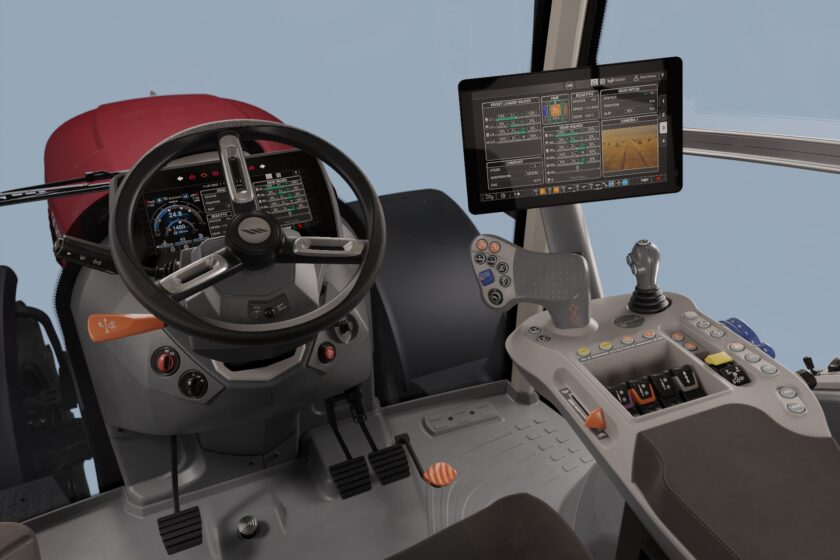
As tradition dictates, the tractor once again took centre stage at Agritechnica. Performance levels and machine size continue to grow, but above all it is innovative technical content that is advancing. Solutions that until recently were exclusive to high-end tractors are now migrating toward mid-power machines, with the aim of making tractors increasingly “smart” — capable of assisting, or even replacing, the operator in daily work.
The German exhibition clearly showed how the tractor is increasingly conceived as an integrated mechatronic platform: a system in which mechanics are driven by electronics through software and sensors. This concept now extends to hydraulics and transmissions as well, with the goal of creating a worksite optimised in terms of efficiency and productivity. It will ultimately be up to farmers to integrate these innovations into everyday operations, distinguishing between solutions that are genuinely functional and those that, at least for now, remain little more than trade-show technology. The following pages present a reasoned overview of the most interesting proposals put forward by the various manufacturers.
The tractor observes, decides and assists the operator
The underlying theme of Agritechnica 2025 was automation, developed along two main paths: autonomous robots and robotised tractors. In the first case, the focus is on solutions that completely eliminate the onboard operator, resulting in dedicated work systems that are less flexible than those achieved by robotising conventional tractors. Not by chance, the latter approach has been adopted by almost all major manufacturers — from John Deere to New Holland and from Kubota to Fendt — through the development of specific retrofit kits offered as optional equipment.

Less spectacular, but no less operationally relevant, are the automated onboard functional systems, such as the one introduced by Claas on its “Axion” series, enabling adaptive management of the driveline. The system analyses the functional states of the engine, transmission, hydraulics and auxiliary users in order to anticipate power demands that typically arise when an implement is lowered at the start of a new pass. As a result, engine speed drops — currently managed manually by the operator — are avoided.
Safety, by contrast, is the focus of the ADAS package presented by Deutz-Fahr to facilitate driving on rural roads. It includes lane departure warnings, turn assistance, recognition of people and obstacles, as well as adaptive cruise control and collision alerts. All functions have been specifically calibrated for typical agricultural scenarios, such as driving on roads without markings while carrying wide implements, or operating multiple machines in close proximity, as is common during forage harvesting.
Also worth mentioning is the Austrian manufacturer Lindner, whose “SmartLift2” system on the “Lintrac 160 LDrive” optimises front-loader operation by modifying steering, hydraulic and transmission responses to ensure smooth and precise manoeuvres.
Electric, modular or hybrid: drivetrains change shape
There was no shortage of new developments on the electrification front. Among the stands in Hannover, modular solutions with multiple motors operating in parallel appear to define the future of electric tractors. The Chinese manufacturer ZSHZ presented a tractor with two side-by-side electric motors: one for traction and one for powering the PTO and hydraulics. LFP batteries with a capacity of 105 kWh are integrated into a front subframe, while fast DC charging up to 115 kW supports the operation of a machine capable of delivering up to 120 hp.

Alongside it — metaphorically speaking, as the stands were far apart — was John Deere’s full-electric proposal: a 130 hp prototype featuring an 800-volt architecture and modular battery packs up to 195 kWh. It uses separate motors for traction and PTO, plus a third unit dedicated to the hydraulic pump. The same technical base will soon be adapted into specialist vineyard and horticultural versions.
Less well known than the American multinational but equally dynamic is the German start-up ONOX, attending its second Agritechnica. It presented a three-motor tractor, with one motor for traction and two dedicated to the front and rear PTOs. The under-bonnet battery offers a capacity of 20 kWh, with additional 30 kWh modules mountable on the lift or side panels. The system operates at 48 volts to remain below the high-voltage threshold.

Still among German start-ups, Tadus deserves mention for its five-motor tractor, the “T 16.20”, which is covered in greater detail in the following pages of this issue.
Alongside full-electric launches, diesel-electric hybrid propulsion systems also made an appearance. Indian manufacturer TAFE is developing a tractor capable of delivering 100 hp using a 75 hp diesel engine supported by two electric motors powered by a 25 kWh battery. China’s Zoomlion, already present in Europe for several years with construction equipment, introduced a new tractor series based on a transmission unit integrated into an electrified rear axle. In this case, output can reach up to 400 hp, delivered by two coaxial motors capable of powering traction and PTO either independently or in combination.
Alternative fuels and “smart” auxiliaries

Despite the arrival of electric propulsion solutions for low- and medium-power machines, internal combustion engines remain the sector’s preferred energy carriers, thanks to their versatility and adaptability to different operating conditions. Many engines are now certified to run not only on conventional diesel but also on alternative fuels such as RME (rapeseed methyl ester) biodiesel and HVO (hydrotreated vegetable oil), derived from vegetable oils, animal fats or even processed urban organic waste. These fuels can fully replace diesel without requiring modifications to tanks or fuel systems, unlike ethanol or methane.
Ethanol, despite having an energy density around 40% lower than diesel, is of interest to countries with strong sugarcane or maize production, as it could reduce dependence on fossil fuels and create a domestic supply chain.
On this basis, Case IH presented a “Puma 240” equipped with an FPT six-cylinder “N67” engine derived from the methane version and adapted for ethanol operation.
On the methane front, New Holland officially announced the market launch of its methane-powered “T6” series, following several years of testing and prototyping.
Overall tractor efficiency, however, is not determined by engine performance alone. For this reason, significant innovations have also been introduced in auxiliary systems and hydraulics. Among these are continuous engine braking systems based on variable-geometry turbochargers or decompression valves that release compression pressure in the cylinders, generating high resisting torque.
Within the AGCO group, Fendt offers an automatic air filter cleaning system on the “800 Gen5 Vario” and “1000 Gen4 Vario” models, extended to the cab filters as well. On the “1000 Gen4 Vario” series, Fendt has also introduced electronic engine management that provides reduced power curves compared to nominal output when implement protection or fuel consumption reduction is required.
Transmissions, traction and hydraulics
On the transmission front, the advance of continuously variable transmissions continues at pace. Fendt has extended its “VarioDrive” solution — an intelligent, permanent all-wheel-drive system — to the new “500 Gen4 Vario” series, while CNH has updated its CVTs for the latest short-wheelbase “T7” tractors with a third forward range and reinforced transmission housings.

Worth noting — more for commercial than technological reasons — is JCB’s decision to equip its new “Fastrac 6000” models with FPT engines paired with ZF CVTs.
Traction-related developments also include onboard tyre pressure control systems, which adjust the tyre footprint according to ground conditions and task requirements, alternately prioritising traction or fuel efficiency. Front axle suspension systems, often with independent wheel layouts, further contribute to maximising traction, while centralised lubrication systems — once reserved almost exclusively for large harvesters — are now increasingly found on implements and tractors, helping to reduce maintenance downtime.
As for hydraulics, the current watchwords are specialisation and digitalisation. Most medium- to high-power tractors feature two separate hydraulic circuits for services and working functions, supplied by variable-displacement pumps and, in some cases, capable of combining into a single high-capacity flow. Traditional load-sensing systems remain widespread, but a new generation of electronically controlled hydraulics, known as “e-LS”, is emerging. Already available on several Fendt series and on the Ropa “Keiler II RK22” potato harvester, this digital connection — called “e-LS Connect” — transmits the load signal via ISOBUS, eliminating the need for a hydraulic connection and improving response speed and precision.
Title: Innovation in agriculture: trends and developments
Translation with ChatGPT
Author: Gabriele Dell’Orto